AI-NATIVE / CONSUMER APP · 2026
AI-native Personal Productivity App
From a passing thought to a plan of action.
When an idea arrives or your hands are full, capturing it should not mean filling out a form. This project explores how AI can turn everyday language into organised tasks and become a more helpful personal assistant over time.
My Contribution
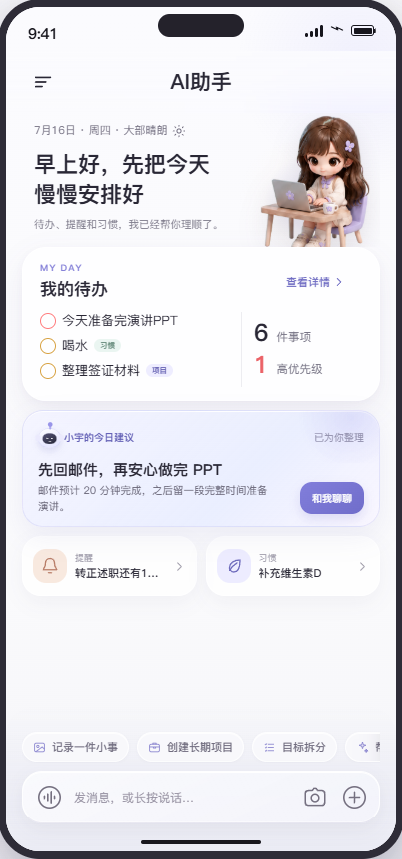
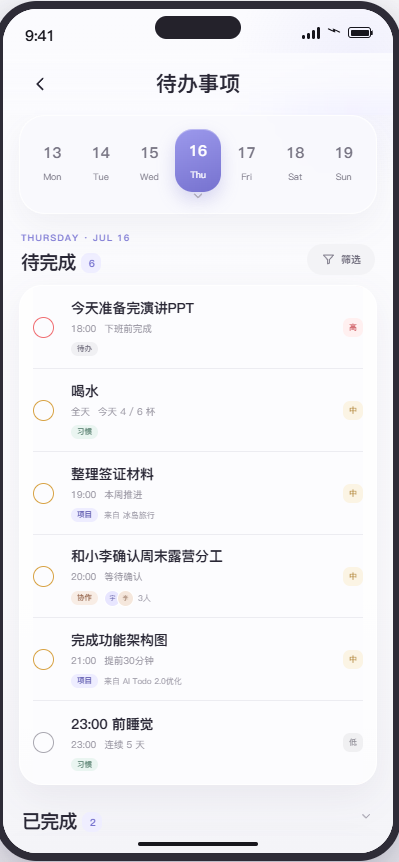
My work covered requirements, product documentation, workflows, UI/UX, interactive prototypes, model evaluation, and prompt iteration. I designed the product's behavioural rules and worked with backend engineers to implement them.
01 / USER PROBLEM
Capture a thought without the form-filling.
A user may want to capture a task while busy, yet conventional tools ask them to set a category, reminder, and priority. I mapped scenarios around errands, work, and ideas, connecting natural-language input to the structured actions that follow.
When the assistant needs more information, A2UI / AGUI presents selectable options, reducing the need to type repeated replies.
02 / PRODUCT LOGIC
Understand intent, not just keywords.
'I want to browse MUJI' might belong on a casual wishlist, while 'I want to pay my credit card bill' describes an obligation. The shared phrase 'I want' should not put both in the same category. I refined the distinction between tasks and casual lists by considering whether an action has a clear completion point and whether it must be done.
I compared model responses against specific use cases, documented mismatches, and refined prompts and intent rules before validating the interactions with engineers.
03 / EXPERIENCE DESIGN
Make room for life beyond productivity.
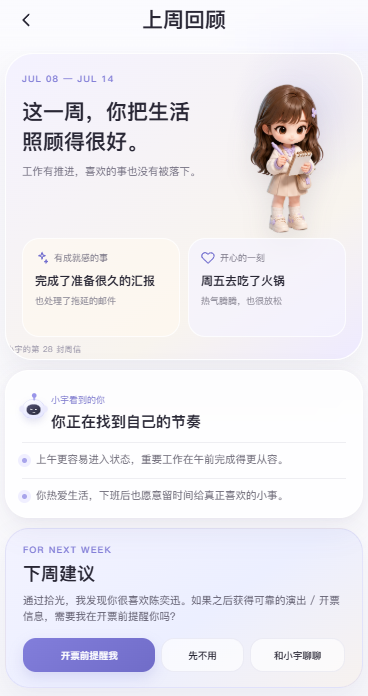
An early version of the weekly review focused on completion rates and how busy the user had been. Returning to the product's supportive purpose, I shifted the emphasis to interests and meaningful everyday moments, so reflection would not become another performance review.
The 'Shiguang' collection feature addresses the difficulty of finding saved content again. It organises screenshots and bookmarks so the assistant can draw on them when helping users recall something or explore recommendations.
04 / VALIDATION
Let concrete use cases guide iteration.
Using PI Web, I compared outputs from DeepSeek, Qwen, Kimi, and other models, documenting issues and rule changes. I tested both prototypes and implemented features, reported findings to engineers, and retested the fixes.
The project was in pre-launch testing. This case study focuses on the design and validation process.